

History
Founded in 1951, Airborne is a historic French furniture manufacturer, recognized worldwide for its major influence on interior design and spatial planning. For over 70 years, our company has been dedicated to designing, manufacturing, and distributing furniture and seating with a timeless style.
Our expertise
The iconic AA chair
The symbol of our expertise: The flagship of our collection is the iconic AA chair. A true icon of 20th-century design, this legendary steel-framed chair has stood the test of time. At Airborne, we perpetuate this heritage by offering a wide range of high-quality covers (leather, linen, cotton, Sunbrella acrylic for outdoor use) suitable for all environments, from the living room to the garden.

Contemporary creation
Beyond our historical heritage, Airborne remains a forward-looking design publisher. We collaborate with talented designers to develop new collections of contemporary furniture (tables, chairs, decorative objects), always respecting our commitment to quality, authenticity, and sustainability.
Choosing Airborne means bringing a true piece of French furniture history into your home.

Airborne Book - The Modernists - Paris
Charles Bernard was born in 1904 in Louhans in the Bresse region.
In 1926, at the end of his military obligations, he returned to Paris, determined to pursue a career in decoration after meeting Pol Pouchol, a decorator and future ceramist whom he had met during his military service.
Pol Pouchol took him in and introduced him to the management of Galeries Lafayette. He was immediately hired as an assistant where he learned the art of model making, drawing and colouring for the creation of objects and decoration commissions for the store.

Entrance hall of the Villa de Suresnes
In 1932, Charles Bernard designed and had his "dream" house built in Suresnes in reinforced concrete, on two open levels, very much inspired by Mallet-Stevens.
In 1933, he set up his own business as an independent decorator. He exhibited objects in numerous salons, objects that attracted attention due to their simple design.
In 1934, he was welcomed into the Society of Decorative Artists and set up a workshop and store at 21 Faubourg Saint Antoine. Among his first clients, the Balajo ordered a series of chairs, followed by the Moulin Rouge bar, which ordered bar stools.
The war emptied part of its workshops and halted the expansion of its activity.
Upon liberation, he returned to his premises but understood that the recovery would be complex.

Club or Manhattan model, more refined than the Standard
In May 1946, while visiting the Paris fair, he noticed on the stand of an English exhibitor some club chairs, sad but with a new level of comfort: the Standard model.
They were manufactured by Airborne Upholstery Ltd, a company run by George Ingram Junior. They partnered and created the company Sobrega. Charles was then tasked with developing this chair and won the US Army market to equip their facilities in Germany: in 1951, they were still delivering one SNCF railway carriage per day….

Airborne factory in Montreuil
In the early 1950s, following the death of George Ingram, his heirs offered to buy back the Airborne name for the furniture sector, first in Europe and then worldwide except for English-speaking countries.
He sells his premises, registers with the steel industry chamber and moves to Montreuil.

Daniel Bernard, one of his sons, and Charles Bernard
Airborne's creation coincided with the specific period of the post-war era and the intense activity of reconstruction. Encouraged by numerous magazines, the French began to focus on their homes and developed a taste for interior design. Alongside Airborne, other brands emerged: Roche (not yet associated with Bobois), Steiner, AtHome, etc.

The G1, designed in 1954 by Pierre Guariche for Airborne
Airborne, in its Montreuil workshops, specializes in the use of metal and round iron. This material allows it, among other things, to create collections intended for Africa. The company also targets the general public. Charles Bernard appoints his son Philippe to develop a network of distributors in the provinces and André Herbomel to develop the network in the Paris region.
These years will produce pieces that will become icons of contemporary design.
(see: designers ).

Structure made of thin sheet metal
Tubular structures give way to structures made of thin sheets, cut, bent and assembled with electric spot welds (Presteel Patent).
A subsidiary is created and managed by Philippe Bernard to distribute furniture intended for public spaces: Prefacto (named after and in homage to the first collection by Pierre Guariche).
Development forces Charles Bernard to relocate to Tournus in a 25,000 m2 building!
Building on its success, Airborne developed a design office and specialized subsidiaries such as Plan System, as well as 17 subsidiaries in various countries, surrounded by his two sons, Daniel and Philippe.
The entrepreneurial spirit is strong, and the know-how, dynamism and creativity are recognized throughout the profession.
Young designers flocked to the company, and Airborne adapted to the emergence of new petroleum-derived materials such as ABS, methacrylate, polyethylene, etc. The use of these materials allowed for the creation of round and colorful furniture! (see the designers )

Philippe Hautefeuille
Philippe Hautefeuille has been in charge of Airborne's communications since 1961.
In 1969, he created this campaign which was rejected by many magazines, except Paris-Match which published it in its issue of September 27, 1969 (others would follow after).
Scandalous for some, questionable eroticism for others, this advertisement will make Airborne talked about in more than 100 countries.
It is said that the photograph was taken in the studio of the sculptor César and that it shows the bare buttocks of the children of the advertising agency's staff....
It will allow the company to increase its export revenue by 40%.
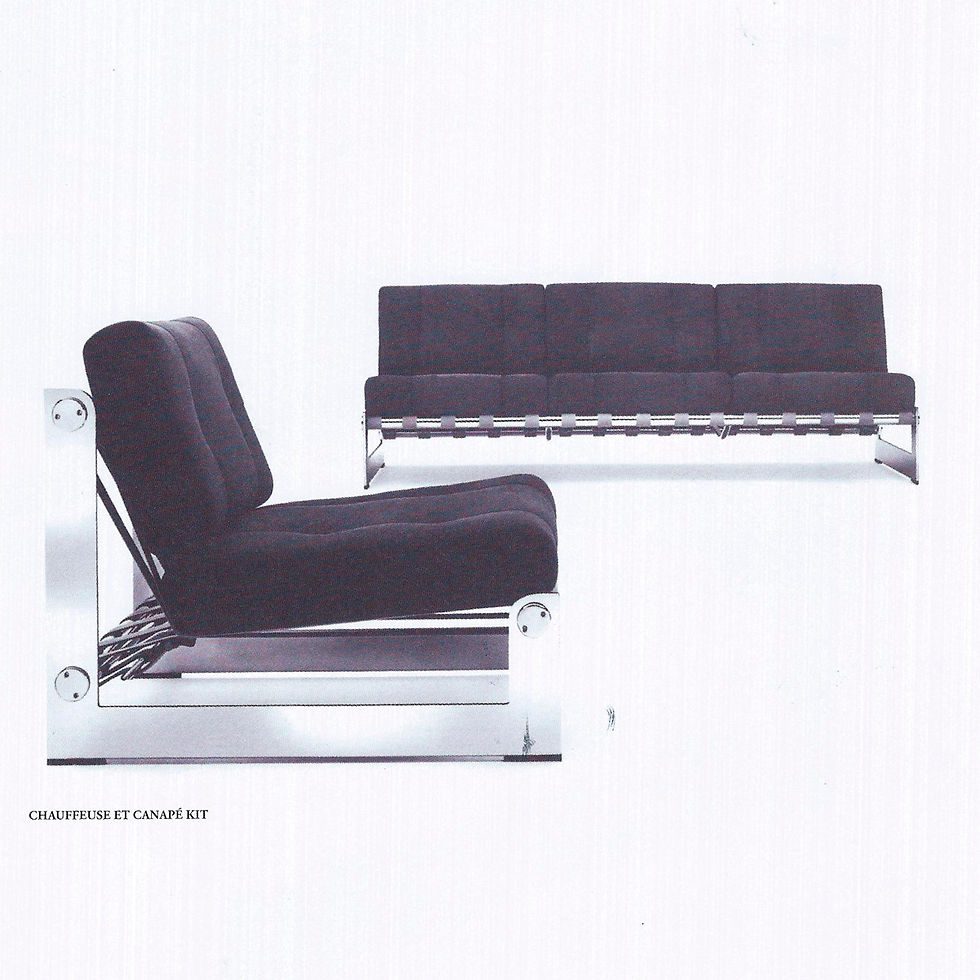
Lounge Chair and Sofa Kit - Gilles Bouchez - Airborne
At that time, Airborne became an internationally renowned creator, publisher and manufacturer: 400 points of sale for Airborne Residence, 300 for Communities, direct sales agencies in about fifteen countries and licensed operators in eight others.
In 1973, turnover exceeded 50 million francs. Airborne exported 22% of its production and was propelled to the top spot among French furniture exporters.
The break occurred as early as 1967. The company failed to notice the societal changes that were taking place.
The business choices and new models lack consistency.

The Potato, a model that participated in the fall of Airborne
However, in 1969, the design office created the Patate. Huge commercial success: Airborne produced 2000 per week...Everyone wanted it: the emerging supermarkets, small shops, Airborne's existing network, etc.
The company can no longer cope, and it's turning into a nightmare: it's plunging the business and its network into chaos. In 1974, the first oil crisis hits, slowing the economy across Europe. Airborne experiences its first-ever drop in revenue. The banks refuse to lend...
The network is losing confidence and the workers are refusing to work part-time to compensate for the company's temporary difficulties.

The AA chair
The bankruptcy filing was announced in May 1975.
Taken over by a local company, Établissements Chambat, then sold for a symbolic one franc to Stafor, the company relocated to Mérignac in the Gironde region. The Tournus site will be reactivated with a limited staff to provide after-sales service for the Patate...
Next came the successive acquisitions by Steelcase, the Fimopart group and then Amatera.
From this period emerged furniture intended primarily for communities and businesses.
In its catalogue, the AA chair still survives amidst the desks and chairs.

AO table designed in 1953 and AA armchair by Airborne
Once again hampered by the 2008 crisis and poor management decisions, Airborne finds itself in liquidation once more.
However, the disappearance of the production sites does not mean the disappearance of the name.
In 2010, Christine Pfeiffer and Patricia Lejeune acquired the company name, its history, and a small stock of AA armchairs and AO tables at auction in Nanterre. They persevered despite malicious companies creating and registering names in an attempt to seize the business and its historical capital. Restarting the company proved difficult. The archives had been plundered by successive owners, and new players continue to appropriate and misuse its documents, even today.

AA Chair Le Labo Design - Airborne
Initially located in Duhort-Bachen in the Landes region and then in Aire sur l'Adour, the recovery was quite rapid.
The company initially focused on reviving the AA chair: today, its catalog offers 57 different covers. Simultaneously, it invited young designers to create a new collection inspired by the incredibly creative 1950s to 1970s. The At-Once design studio successfully joined this new venture and has already designed a new coffee table and a new bridge chair for Airborne.
Today, with its network of 300 design stores in France and 200 abroad, it intends to become a fully-fledged French publisher again.

Maxime Lis and the Assisi published by Airborne
Maxime Lis joined the team as artistic director in 2022 alongside the designers and the commercial team.
His expertise, his sense of creativity, and his understanding of historical value enrich us every day. Together, we are writing a new chapter in Airborne's history, inspired by its glory days between 1951 and 1974: years when only creativity and imagination reigned supreme. We continue to dream :)

Guariche or Prefacto program
Charles Bernard's personal qualities attracted young talents to his company: his knowledge of manufacturing and his gifts for drawing enabled him to mobilize designers, the first of whom was Pierre Guariche.
It was from 1952 that Airborne began marketing the famous Prefacto program, the only industrial modular furniture of that era.
In 1954, Pierre Guariche designed the famous G1 which would still appear in 1972 in the Prisunic catalogue, then an Airborne distributor.
Shortly afterwards, he designed the G10, in the same spirit of adaptability: a screw and bolt joining system on the metal structure allows them to be joined together into a two or three-seater bench.
It is a model that is both elegant and practical, meeting multiple needs, both domestic and professional. Its production ceased in 1963/1964.
Pierre Guariche

Raoul Guys - Antony Armchair - Airborne
The arrival of "reinforcing steel" makes it possible to produce models adapted to communities at a lower cost.
Thus Airborne will equip, in the same way as Jean Prouvé, part of the university city of Antony with two seats specially designed by Raoul Guys: Antony Armchair and Chair.
Charles Bernard, still in partnership with Raoul Guys, developed Oro, a series of rattan and painted iron furniture that was both lightweight and durable. Air France chose this collection to furnish its African hubs (24 locations), including the major hotels in Brazzaville.
In 1954, the design office conceived a collection with a metal base reminiscent of that of the AA. Of this range, only the T3 (or Jasmin) coffee table has survived, now called the AO table and available in several versions.
Raoul Guys

Model 320 - Airborne
Airborne also offers designs by René Jean-Caillette: the 310, 320, 340 and 530, the ultimate models with a wooden frame.
René-Jean Caillette

CL106 Airborne Bench Seat
In 1958, another young designer, André Simard, entered the scene with his CL106 bench seat, the C60 and the 106 chauffeur seat.
André Simard

The Villafranca desk and the P60 chair
In 1960, for their first participation, Antoine Philippon and Jacqueline Lecoq designed a chair with a very pure line: LA P60.
In 1969 they proposed a prestigious office, the Villafranca, which would become Charles Bernard's office in Tournus.
A. Philippon
& J. Lecoq

The Joker - Airborne
1960 also marks the arrival of the young Olivier Mourgue. Through his creations and dynamism, Olivier Mourgue will become an essential player in the company, in proportion to the international development of his reputation as a designer.
The Joker, his first creation for Airborne, had a slow start before achieving real commercial success.
In 1963, he designed a futuristic model: the Djinn. This collection greatly contributed to the development of Airborne's international image: tens of millions of viewers were able to see it in the setting of the film "2001: A Space Odyssey", directed by Stanley Kubrick.
For the occasion, Djinn was dressed in vermilion red and Tyrian pink.
With such a reference, it became the avant-garde model of the time, also the first production seat consisting of a foam padding covered with a removable Jersey fabric cover.
That same year, he designed Tric-Trac, which unfortunately only 5 copies were made due to the complexity of its creation.
A model is kept at the Museum of Decorative Arts.
In 1964, Olivier Mourgue proposed Whist.
This model is proving successful in public places such as airport lobbies and waiting rooms.
Olivier Mourgue designed the Montréal armchair for the main hall of the French pavilion at the 1967 Montreal World's Fair. It was later produced in a very limited edition by Airborne. This armchair is part of the Mobilier National collection. Its organic shape makes it an emblem of the 1960s.
Olivier Mourgue

Daniel Quarante - Albatross Armchair - Airborne
In 1969, Danielle Quarante designed the Albatros armchair, for which she received the Henri Mercier prize for best creation.
Charles Bernard is won over: Airborne will produce this armchair.
The company produces around twenty units per month, mostly in white. The Albatros is part of the permanent collections of the Musée des Arts Décoratifs in Paris and the Musée du Plastique in Brussels.
Its production ceased in 1975.
Danielle Quarante

Blooming Chair - Airborne
In the mid-1960s, Yves Christin, a recent graduate of the School of Applied Arts and the Conservatoire des Arts et Métiers, joined the Airborne design office. His first creation was the Blooming chair, which combined the company's expertise in bending steel tubing with the new material, methacrylate. He chose the concept, daring for the time, of a suspended seat made of Altuglass. This chair was complemented by a round, slightly smoked-topped table.
Yves Christin presented the interesting combination named Romulus in 1969.
The press success will be significant, most often presented with a striped fabric, but it is in the white imitation leather version that it will find its true identity and its reception with the public.
Yves Christin also designed for Airborne the Storm armchair and lounge chair which remained in the catalogue until the end of the company and the very beautiful Lucullus model, intended for communities.
Yves Christin

Clover Chair - Airborne
Designed for Airborne the Agathe chair (star of the Europlastique trade fair in 1970) and the Trèfle swivel chair with polyester shell.
Christian Adam

Amoeba Chair Prototypes by Verner Panton at Airborne
It was created by Charles Bernard at the beginning of the company but became a fully independent department in the late 1950s.
He was the one who developed the Presteel patent in the 1960s. His reputation is such that it is considered by the profession as the most efficient research and development site.
Verner Panton and the Mobilier National called upon him to create numerous prototypes.
From 1973 onwards, deprived of its main creator, Olivier Mourgue, the company increasingly turned to its design office.
From this department came in 1969 the famous Potato chair, both a huge commercial success and the beginning of the end for Airborne (see "Airborne, a French saga")
The design office's greatest achievement was the 3000 Series released in 1973 because it incorporated a new technique: foam injection, which paved the way for new generation seats in the automotive sector.
But the development studies were too expensive to hope for a return on investment.
In its 25 years of existence, this service has welcomed many creators such as Christian Germanaz, Yves Christin, Jean-Claude Lecubin, François Jodeau, Bernard Marange, Germain Pernet, Christian Adam, not forgetting Daniel Bernard, his son, himself a designer.
The Design Office
The AA chair
The bankruptcy filing was announced in May 1975.
Taken over by a local company, Établissements Chambat, then sold for a symbolic one franc to Stafor, the company relocated to Mérignac in the Gironde region. The Tournus site will be reactivated with a limited staff to provide after-sales service for the Patate...
Next came the successive acquisitions by Steelcase, the Fimopart group and then Amatera.
From this period emerged furniture intended primarily for communities and businesses.
In its catalogue, the AA chair still survives amidst the desks and chairs.
Add a Title
AO table designed in 1953 and AA armchair by Airborne
Once again hampered by the 2008 crisis and poor management decisions, Airborne finds itself in liquidation once more.
However, the disappearance of the production sites does not mean the disappearance of the name.
In 2010, Christine Pfeiffer and Patricia Lejeune acquired the company name, its history, and a small stock of AA armchairs and AO tables at auction in Nanterre. They persevered despite malicious companies creating and registering names in an attempt to seize the business and its historical capital. Restarting the company proved difficult. The archives had been plundered by successive owners, and new players continue to appropriate and misuse its documents, even today.
Add a Title
AA Chair Le Labo Design - Airborne
Initially located in Duhort-Bachen in the Landes region and then in Aire sur l'Adour, the recovery was quite rapid.
The company initially focused on reviving the AA chair: today, its catalog offers 57 different covers. Simultaneously, it invited young designers to create a new collection inspired by the incredibly creative 1950s to 1970s. The At-Once design studio successfully joined this new venture and has already designed a new coffee table and a new bridge chair for Airborne.
Today, with its network of 300 design stores in France and 200 abroad, it intends to become a fully-fledged French publisher again.
Add a Title
Maxime Lis and the Assisi published by Airborne
Maxime Lis joined the team as artistic director in 2022 alongside the designers and the commercial team.
His expertise, his sense of creativity, and his understanding of historical value enrich us every day. Together, we are writing a new chapter in Airborne's history, inspired by its glory days between 1951 and 1974: years when only creativity and imagination reigned supreme. We continue to dream :)
Add a Title

Model registered in 1881 by JB Fenby
In 1855, Joseph B. Fenby, a British engineer, designed a folding wooden chair, the Fenby Chair. He registered the design in the United States in 1881. Produced from 1895 onwards by the American company The Gold Medal Inc., it became a favorite chair among military personnel. Lightweight, foldable, and with a removable cover, it was easily transportable.
Presented at the 1904 St. Louis World's Fair, its manufacturing rights were sold to several European countries. It then joined the ranks of the British and Italian armies during their maneuvers in Libya. Practical because of its excellent stability in the sand, it earned the nickname "Tripolina Chair."
Since then, many companies around the world have manufactured it in different versions: leather or fabric.

Plan of model 198 or BKF
In 1938, two Argentinian designers, Juan Kurchan and Jorge Ferrari-Hardoy, associated with a Catalan designer, Antonio Bonet, were inspired by the Fenby Chair to create an armchair for their architectural firm: the “BKF” armchair, or “198”, was born.
They replace the wood with solid steel wire and use leather, which is cut into 4 pieces.

BKF at the MoMA in New York
Credit: Edgar Kaufmann, Jr.
In 1940, they presented their creation at the Salon of Decorative Artists in Buenos Aires and won two first prizes.
The BKF was spotted by the director of the Museum of Modern Art in New York, Edgar Kaufmann, Jr., who brought it into the MoMA in 1944.

Hardoy Chair by Knoll
From 1941 to 1947, Artek-Pascoe manufactured it, then Knoll Associates Inc. from 1945 onwards for the American market. The latter quickly ceased production because, as the design was not patented, it was copied in many countries.

CONTEMPORARY ARCHITECTURE
It was in the USA that André Bloc, editor of the magazine ARCHITECTURE D'AUJOURD'HUI, noticed it. He brought a copy back to France and initially shared his discovery with Raoul Guys, a small furniture manufacturer and owner of the La Brouette gallery. Guys decided to immediately distribute the BKF chair. At that time, he encountered difficulties in getting it manufactured. When André Bloc finally showed the chair to Charles Bernard, Bernard quickly grasped the model's potential and approached Raoul Guys, who offered to take over its production. Airborne, in fact, had a perfect mastery of the round iron technique.
Some time later, Charles Bernard absorbed Raoul Guys' activities.

Daniel Bernard, one of his sons, and Charles Bernard
This is how the AA became the star of the Airborne company.
From 1952 onwards, the one-piece lacquered metal frame was sold in several versions: black, green, red, yellow, or white, and the removable cover was made of very thick awning canvas, also available in 5 colors. The most luxurious version was the chrome frame with a leather cover.
At that time, tanks large enough to chrome the entire structure could not be found in France. Charles Bernard therefore decided to "cut" it in 2: a base, two ears and 4 sleeves.
This is the version that Airborne continues to sell today.

White stitching on a cotton cover
There is another Airborne trademark dating back to the 1950s: the cotton covers are sewn with a double white stitch in the center and on the edges, which reinforces the sturdiness of the seat.
Today, they are available in 14 different colors

AA label by Airborne
The covers are always signed AA by Airborne and since 2011, the frames are engraved AA followed by the year of manufacture.

BB armchair by Anne-Claire Petit
In 2011, a similar structure was also created for children: the BB by Airborne with a range of colorful and playful covers.

AA armchair with a stainless steel frame,
seaweed cotton cover
In 2011, Airborne created a structure made of 316L marine-grade stainless steel. The chrome-plated structure was abandoned because it was too fragile and, more importantly, its manufacturing process no longer met acceptable environmental standards. The use of stainless steel also allows for outdoor use.

AA armchair, Lhasa model
In 2023, the AA remains Airborne's flagship product. There are 57 different covers available, ranging from chainmail and batyline to leather, cowhide, and more.
The history of AA is fascinating, and Airborne continues to write its sequel day after day…


Jeremy Bergeaud
Designed by Jérémy Bergeaud
entirely made in France
lightweight and stackable
The H Chair, designed by Jérémy Bergeaud, perfectly embodies the Airborne spirit. Lightweight, stackable, and versatile (indoor and outdoor), it continues the AA legacy with an evolving approach: its upholstery is interchangeable, allowing you to adapt its appearance and function to suit your needs. It boasts a sleek silhouette, both familiar and instantly recognizable: its understated yet assertive design gives it a true identity. To describe its comfort, we could evoke that of the legendary screenwriter's chairs, true furniture icons whose seating has been tried and tested... but the best way to experience it is to try it yourself. The H Chair is featured in Airborne's new 2026 catalog and is available for purchase by retailers and professionals. Contact us by email or phone for a personalized quote.